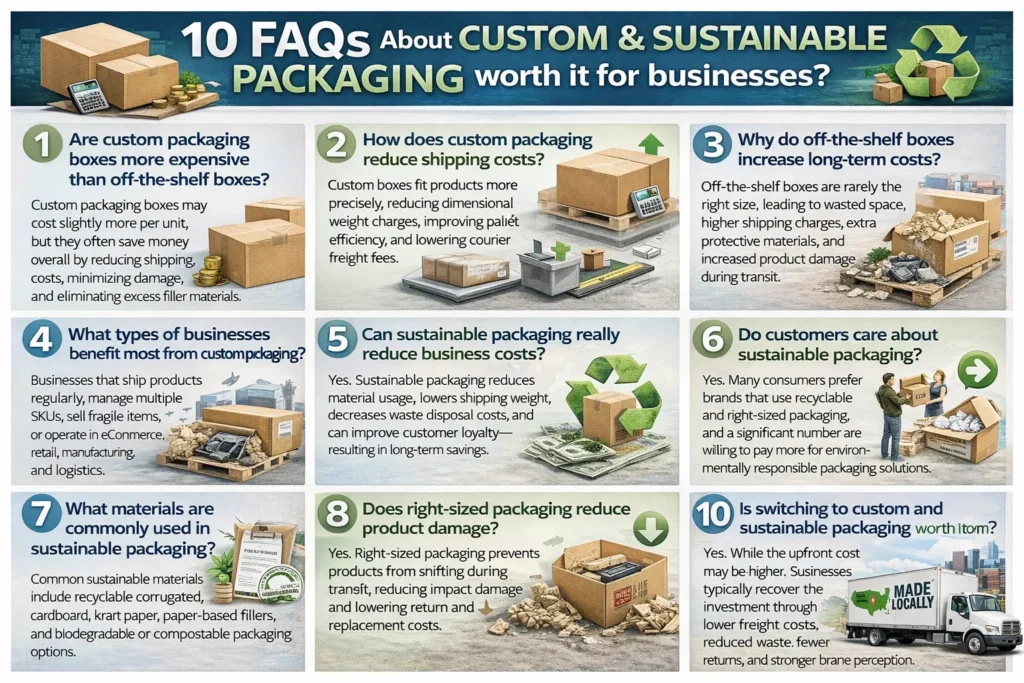

Johannesburg businesses can reduce packaging box costs by choosing suitable sizes, comparing equivalent board specifications and ordering around actual demand. Buying locally may simplify supply, but savings should be measured across the whole packed shipment.
Rennow Projects supplies packaging boxes from 145 Diesel Road, New Era, Springs. Use these ten checks before placing your next order.
How Packaging Affects Your Costs
A box influences material use, packing time, storage, transport and the risk of product damage. A cheap box that fails can cost more than a suitable alternative. An unnecessarily large box may also require extra filler and attract higher charges under a courier’s dimensional-weight rules.
10 Ways to Save on Packaging Boxes
1. Measure the Packed Product
Measure length, width and height, allowing enough room for necessary cushioning. Confirm whether quoted box dimensions are internal or external. A box should fit the complete packing system, not squeeze the product.
2. Match Strength to the Load
Explain product weight, stacking and handling conditions to the supplier. Ask for the appropriate board grade and available strength information. Wall count alone does not establish a safe load.
3. Compare Standard Sizes
A standard size can offer good value when it fits your products. Check actual packed dimensions against your courier’s current pricing; couriers do not all use the same size rules.
4. Buy in Useful Quantities
Ask about price breaks and minimum quantities. Balance any bulk discount against storage space, cash tied up and the risk of unused stock. Confirm repeat-order lead times.
5. Choose the Right Box Construction
Folding cartons and corrugated boxes serve different purposes. Select a construction that withstands the intended handling rather than treating all cardboard packaging as interchangeable.
6. Consider Mailers Where Appropriate
A suitable mailer may work for some small or non-fragile items. It is not automatically stronger or cheaper than a box. Test its closure, surface protection and suitability for the delivery route.

7. Compare Like-for-Like Board Grades
Ask suppliers to quote the same dimensions, board specification, quantity and print requirements. Review samples if changing grade or supplier. Do not reduce protection simply to lower the unit price.
8. Include Supplier Service in the Comparison
Confirm stock availability, delivery charges, quote validity and the process for resolving incorrect or damaged supplies. Clear order specifications help prevent expensive misunderstandings.
9. Keep a Practical Range of Sizes
A small set of well-chosen sizes can cover common products while keeping inventory manageable. Use order history to identify which sizes earn their storage space.
10. Calculate the Total Cost per Shipment
Include the box, tape, cushioning, labour, delivery charges and damage-related costs. Test changes on representative shipments before adopting them across the business.
Request a Box Quote from Rennow Projects
Share your dimensions, product weight, quantity and required date with Rennow Projects. We can discuss available packaging options for your Johannesburg business and confirm collection or delivery arrangements.
Contact us on WhatsApp 061 514 8053 or find us at 145 Diesel Road, New Era, Springs.